How to Survive the Squeeze
How a Small Hardware Brand Survives Between Amazon and Hermès
I don't know about you but I have too many cords. Here is just one box in my office. Just one.
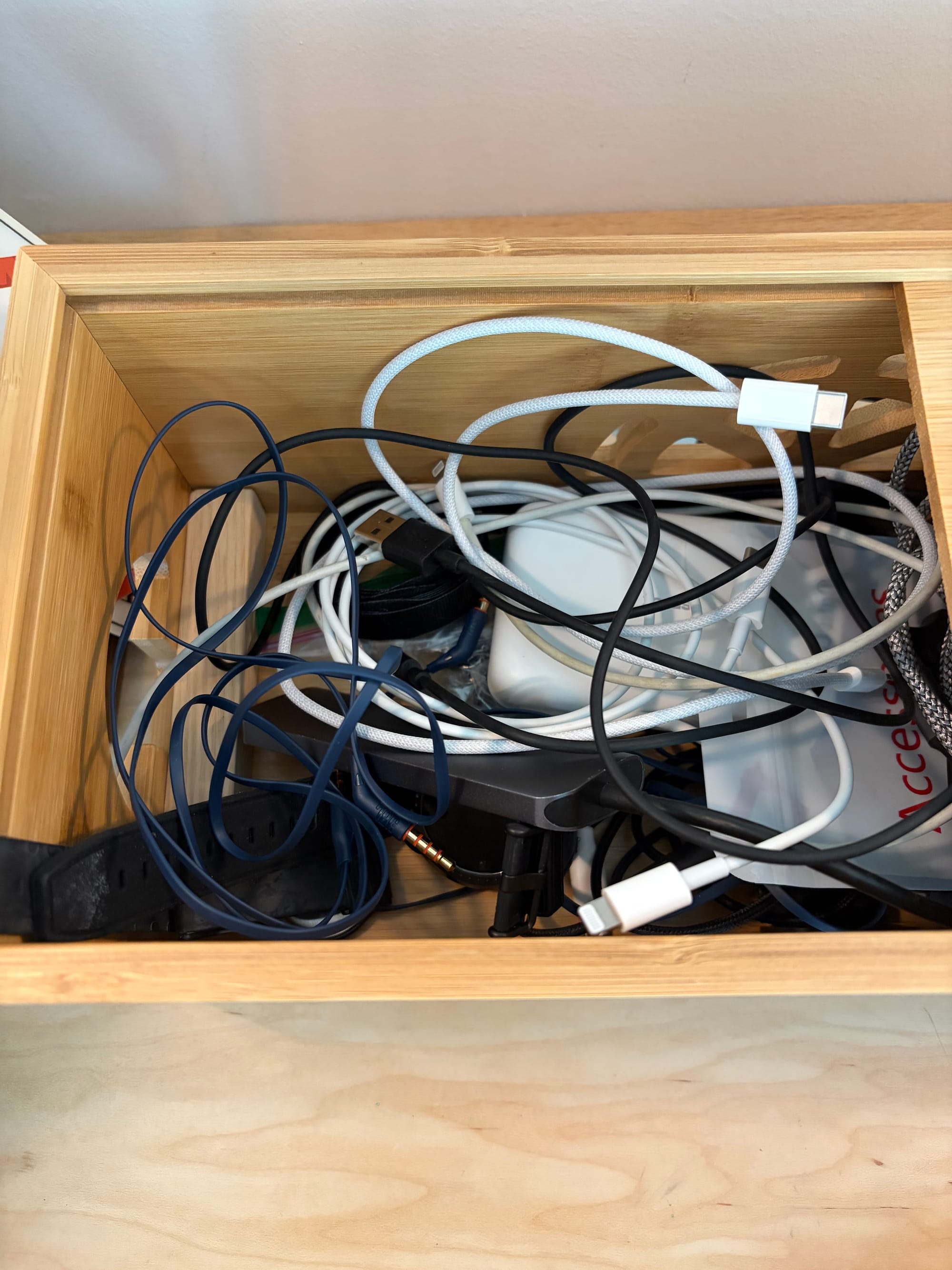
There are Phone cord, AirPods cord, laptop cord, Whoop chargers, JBL speaker cords, even an amp cord slipped in there….this box in my office is the definition of disarray. And lets not even get into the fact that everytime I buy a new Apple product they require a new one. My bet is you do too. We've all accepted that the price of modern life is a slow accumulation of cords that metaphorically strangle us.
I always wanted to fix it. So I started looking at wireless chargers. And that's where it got weird.
The first thing I noticed was that there are essentially two kinds of wireless chargers in the world right now. There's the $19 one on Amazon, the one made out of cheap plastic with the brand name you've never heard of that you suspect doesn't exist outside of the listing. And then there's the Hermès one. Yeah, Hermès makes one. It costs $1,700 and is upholstered in calfskin. Not making this up.
Somewhere between those two there has to be a place where a regular person who cares about how their house looks can find a charger that does the job, doesn't fall apart in six months, and doesn't require a second mortgage. But that middle is really hard to find. And it turns out it's way harder to build.
So I called the guy who's trying to build it.
His name is Adam Bdoyan. He runs a company called NYTSTND.
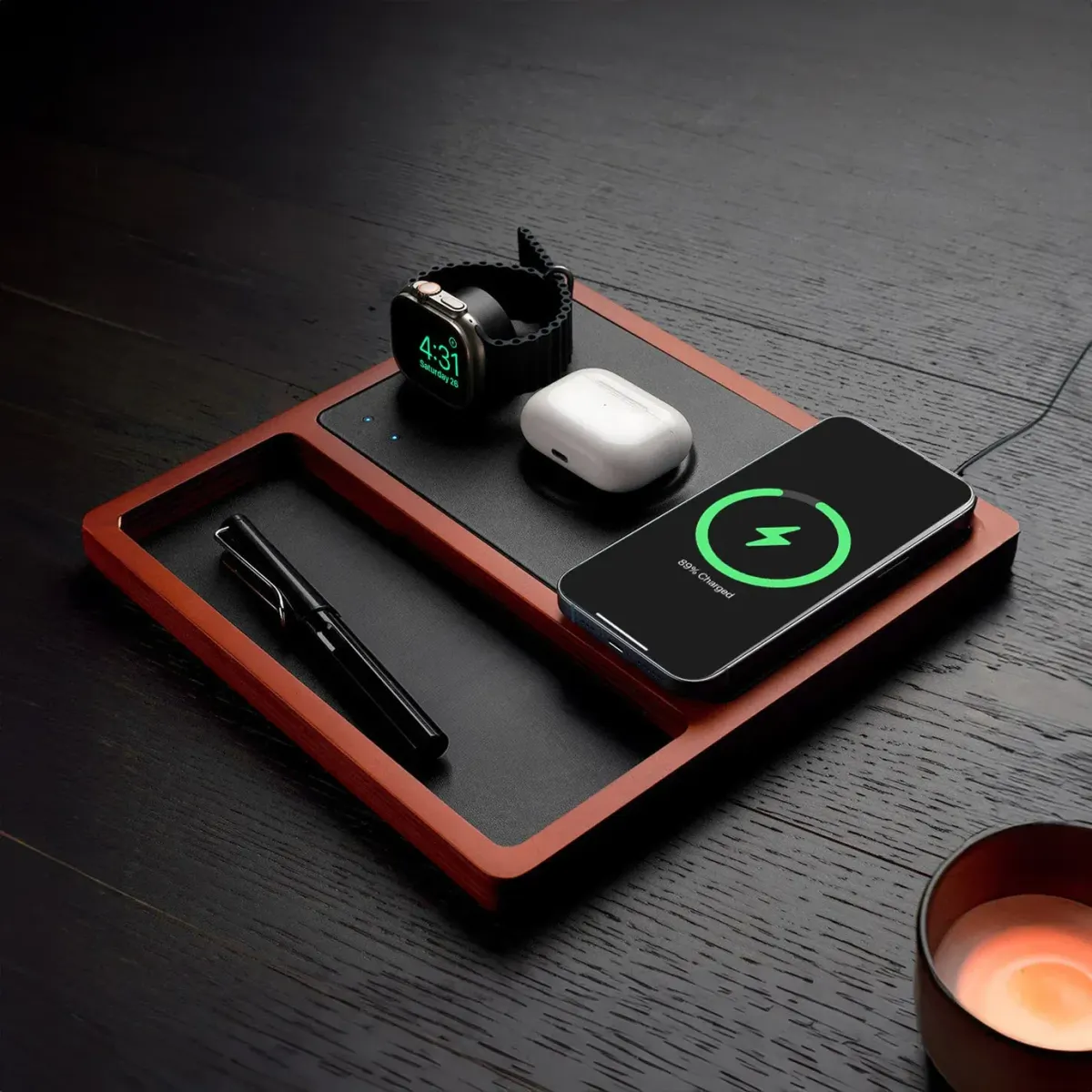
They make premium wireless chargers out of leather and wood. I bought one because it looked like furniture instead of an appliance - I actually LIKE having it out in the office. Whoda thunk? Of course, I got curious about the company, because every time I look at the world of small consumer hardware brands these days, it's littered with dead bodies. So how does NYTSTND survive when one side of the market is selling chargers for $19 and the other side is selling them for $1,700?
Adam, it turns out, is one of the more interesting founders I've talked to. He got his electrical engineering degree in Soviet Armenia in 1978. He transitioned to software after the Soviet collapse. He built an EdTech company called ShowMe.com that reached 26 million users. He sold an outsourcing software business out of Ohio. And then, in what seemed like the least obvious next move, he got into wireless charging hardware. The man has lived four professional lives. This is his fourth.
Here's what he told me about how he's surviving the squeeze.
Me: Let's start with the obvious one. Why is the wireless charging market split between knockoffs and luxury, with almost nothing in the middle?
Amazon is full of public products. That's what they're called in the industry. ODM hardware from platforms like Alibaba, where five different brands sell the same physical product under five different logos. The quality is whatever it is, the margins are razor thin, and the customer can't tell who made it. At the other end, you have Hermès selling a wireless charger for $1,700. Above us, below us. Almost nothing in between, because the middle is the hardest place to compete.
This blew me away. It's like something you figured but until you heard its impact on people like Adam you had no idea how big it was. The middle is hard because both ends are easy in different ways. Knockoffs win on price and don't care about quality. Luxury wins on brand and doesn't care about price. The middle has to win on product, and product is the most expensive thing to get right.
Me: So how do you compete from the middle? What's the actual strategy?
We don't compete on price. We can't. And we don't pretend to be luxury, because we're not. What we do is treat charging stations as home decor instead of electronics. We use leather and wood. We design for the room, not for the spec sheet. The same way a high-end car interior is designed. You don't notice the engineering. You notice that it feels nice.
This is the move I missed when I first bought the product. I thought I was buying a charger. I was actually buying a cool piece of furniture that happens to charge things. The reframe is the whole thing. Once you stop competing in the charger category and start competing in the home decor category, the comparison set changes completely. You're no longer next to the $19 Amazon brick. You're next to candles, lamps and vases.
Me: Tell me about the decision to stay off Amazon. That feels counterintuitive for a small brand trying to grow.
Amazon would kill us. Not because of competition, exactly. Because of positioning. The moment a NYTSTND product is sitting next to twenty ODM chargers from brands nobody has heard of, we look like one of them. The whole point of the brand is that we are not one of them. So we sell on our own site, direct, and through partners like Williams Sonoma. We're willing to grow slower in exchange for staying out of the noise.
Most founders I know would have caved on this by year two. The Jeff Bezos pull is real. Amazon revenue is real, and the conventional wisdom says you have to be where the customers are. Adam's argument is that being where the customers are matters less than being where the right customers are, and the right customers for a premium home product aren't browsing Amazon for the cheapest charger they can find.
Me: The Williams Sonoma partnership is interesting. How did that come together?
Williams Sonoma offers customization on our products, including leather engraving. That partnership has been one of our most important. We recently shipped 100 of our trio units for a corporate trade show giveaway, all engraved. That kind of order doesn't happen on Amazon. It happens because we built the kind of product that someone wants to give as a gift, with their logo on it, to people they're trying to impress.
Here's the part where the strategy really works. The reason to stay out of Amazon isn't just brand positioning. It's that staying out of Amazon makes you eligible for partnerships with brands like Williams Sonoma, who would never carry a product they could find on Amazon for half the price. The discipline of saying no in one place creates opportunity in another.
Me: What about new categories? The instinct for a small hardware brand is usually to expand the line as fast as possible. Are you doing that?
We just launched a new product called Orbe Audio. It's a speaker with a 25-watt wireless charger built in. It's for the places in your house where you spend time but don't have a good spot for your phone. The kitchen counter, the bathroom, the office desk. Pre-orders just opened. But we're not trying to be a speaker company or a hardware company in general. We're trying to solve the problem of charging in a way that fits the room. Orbe Audio is an extension of that idea, not a new direction.
This is the same discipline I saw with Bad Birdie when I talked to Jason Richardson a few weeks ago. Small brands that survive don't lose their core vision. They build off the existing thesis and stay in their lane. The thing that kills most D2C founders isn't the market. It's the founder's own restlessness, the inability to keep doing the boring focused thing that works.
Me: Last question. What do you actually believe about the future of wireless charging?
That everything wireless. Not just phones. Cars, robots, household devices, everything that has a battery. The cord is a historical accident. We have it because we haven't built the alternative yet. Twenty years from now, plugging something into a wall will look like winding a watch. Quaint. Outdated. We're building for that world.
That's the bet underneath the whole business. Not just that NYTSTND will survive the squeeze, but that the squeeze itself will eventually go away because the category will grow up. Right now you have $19 knockoffs and $1,700 calfskin novelties because the market is immature. As wireless charging becomes the norm for every device in your house, the middle stops being squeezed. It becomes the entire market. That's the bet.
So how does a small hardware brand survive between Amazon and Hermès?
Not by competing on price. Not by trying to become luxury. By changing the category you're competing in, by being disciplined about where you'll sell and where you won't, by finding partners who only work with brands that aren't on Amazon, and by extending one good idea instead of chasing many. Adam's not winning by being cheaper or fancier. He's winning by being clearer about what he is and what he isn't.
But man, the squeeze is real. The middle is hard. There is a way through it, and it looks like making something beautiful enough that you stop comparing it to what's around it.
I have one of his chargers in my office now. The cord drawer in my kitchen is still a disaster. But the room I work in now is looking simpler and has something else worth looking at.
Take a look at what Adam and his team are building at nytstnd.com.
If you want to be notified when I publish something new, you can subscribe here.
— Sean